Hyperconverged infrastructure (HCI) can absolutely deliver in cloud-connected SMB and mid-market environments, but only when it is treated as a hybrid platform choice, not a magic simplification wand. HCI still does what it originally promised: consolidate compute, storage, networking, and virtualisation into a managed cluster that can scale by adding nodes and reduce day-to-day operational friction.
What has changed since the early HCI hype cycle is the environment around it. Most organisations now run multi-cloud and hybrid by default, face sharper cost scrutiny, and must build cyber resilience to satisfy customers, regulators, and increasingly cyber insurers.
The practical verdict: HCI delivers strongly for local performance, predictable operations, and high availability in a cloud-connected design. It falls short when buyers expect it to behave like elastic cloud, underestimate licensing and scaling trade-offs, or bolt it into a hybrid estate without proper identity, DR, backup, and Zero Trust foundations.
HCI is best understood as an on-premises (or edge) platform that packages the core infrastructure layers into a single cluster. Definitions vary slightly, but the consistent theme is software-driven integration of compute, storage, networking, and virtualisation with centralised management and scale-out expansion.
The original promise for SMB and mid-market was straightforward: fewer silos, faster deployment, fewer specialised skills, and a cleaner path to resilience because data is distributed and workloads can fail over within a cluster.
What is different in 2026 is that HCI is no longer just a data centre consolidation play. Many HCI narratives now position it as a bridge to private cloud and hybrid operations, extending consistent management and recovery patterns across sites and, in some designs, into public cloud integration for backup or disaster recovery.
Cloud-connected does not mean cloud-only. Recent industry survey data shows the centre of gravity continues to shift toward hybrid and multi-cloud, with nearly half of workloads and data now in public cloud environments and multi-cloud usage widely reported.
Cost pressure is not theoretical. Flexera reports that managing cloud spend is the top cloud challenge for 84% of respondents, with budgets exceeding limits and heavy reliance on managed service providers and FinOps teams to regain control. This matters for HCI because the buying conversation has shifted from “move everything to cloud” to “prove unit economics and governance across cloud, SaaS, and data centre.”
The collaboration and identity layer is also largely cloud delivered. Microsoft positions Microsoft 365 as a platform bringing together Office, Windows, Copilot, and Enterprise Mobility + Security, reinforcing how productivity and security tooling are increasingly cloud anchored even when core workloads stay local.
Remote and hybrid work remains structurally embedded, which raises the baseline expectation for uptime, secure remote access, and consistent performance. In Great Britain, the Office for National Statistics reported that 28% of working adults were hybrid working in autumn 2024 and described hybrid as the “new normal” for around a quarter of workers.
Edge is also growing because not everything can tolerate latency, connectivity reliance, or data movement costs. Computer Weekly, citing IDC research, reported global spending on edge computing services near $261bn in 2025, projected to reach $380bn by 2028. In parallel, cyber resilience expectations are escalating. Marsh explicitly lists MFA, patching, cyber training, and backup information among the details applicants should be prepared to answer in cyber insurance applications.
Where HCI delivers and where it fall short
HCI adds clear value when it is used for the workloads and operating models it is structurally good at.
In performance and user experience terms, HCI’s pooled local storage and clustered design can provide low latency for virtualised workloads, databases, and branch site services. In operational terms, centralised management and integrated lifecycle workflows can reduce “tool sprawl” and speed up provisioning, which is attractive where IT teams are small and have zero appetite for babysitting a SAN at 2am. For redundancy, multiple sources describe distributed data and clustering as an availability mechanism, reducing single points of failure when designed with enough nodes and the right policies.
Cost predictability is the more nuanced win. HCI can improve predictability versus variable public cloud consumption for steady workloads, and it can align capital refresh with a known node-based expansion pattern. The catch is that predictability only appears when the cluster is right-sized and governance is solid.
Where HCI falls short is mostly about expectations mismatch.
First, cloud misalignment. HCI is owned infrastructure. You still patch, secure, capacity plan, and deal with hardware lifecycle. If you buy HCI expecting “elastic like cloud,” you will be disappointed because scaling typically means adding nodes, not sliding a consumption bar.
Second, licensing and premium stack economics. Independent analysis notes that software licensing and maintenance can drive ongoing costs, and that node bundles can force you to buy resources you do not need in the moment. This is the “single pane of glass” joke. The invoice is also a single pane, and it can still break the budget.
Third, scaling inefficiencies. A widely cited structural issue is resource coupling. If you mainly need storage capacity growth, you may be forced to add compute you do not need (or the reverse).
Finally, hidden complexity. HCI can make the platform easier to operate, but it does not remove the need to correctly design resilience, networking, backup, and recovery. Industry commentary highlights that the simplicity users see can hide significant complexity around resiliency behaviour and failure scenarios.
Practical hybrid integration checklist with decision tools
If you are considering HCI in a cloud-connected SMB or mid-market environment, treat the decision as “hybrid architecture selection.” A practical checklist that aligns to today’s threat and insurance realities looks like this:
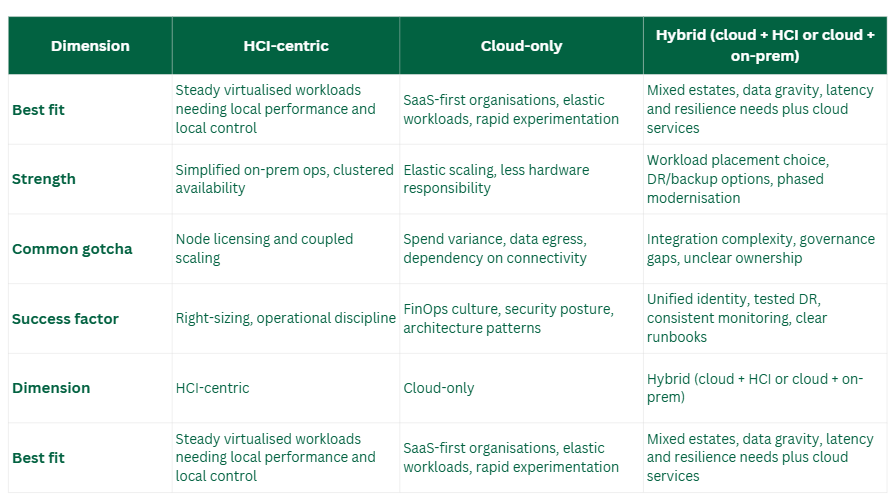
A simple comparison can help anchor expectations. This is not about right versus wrong. It is about matching operating model to workload reality.
Use cases, verdict, and recommendations
Three real-world mid-market style patterns show where HCI tends to land when cloud connectivity is already the norm.
A mid-sized retailer in Spain, Grupo Ali, reported improved reliability after moving to a hyperconverged solution used across physical and online retail operations, explicitly linking the change to fewer interruptions in sales processes. A Japan-based healthcare manufacturer, Shofu, adopted an HCI appliance (three-node class) to enable remote server management, while also modernising endpoint provisioning for roughly 150 employees. Lenovo And the University of Canberra describes modernising data protection with cloud storage and integrating with existing HCI and public cloud, tying the outcome to measurable savings and faster backup and restore performance.
So, is HCI delivering for cloud-connected SMB and mid-market environments? Yes, when it is used to provide resilient local infrastructure for workloads that need it, and when it is integrated into cloud identity, security, backup, and DR patterns with cost governance. No, when it is bought as a “cloud replacement” or when organisations ignore the operational and scaling realities, especially licensing, right-sizing, and resiliency design.
Recommendations for IT decision makers: treat HCI as one component of a hybrid reference architecture, decide workload-by-workload, insist on tested recovery (not just configured recovery), and make cyber insurance controls part of the infrastructure acceptance criteria from day one.
Recommendations for channel partners: lead with governance and measurable outcomes, bundle HCI with FinOps-style cost visibility and security-by-design controls, and productise continuous testing of backups and DR because insurers and auditors are going to ask anyway.
Where can we help?
Hyperconverged Infrastructure can be a powerful foundation when it is designed with intent and aligned to real business needs. The difference between a high performing hybrid environment and an expensive misstep often comes down to architecture, integration, and long term planning. At Inlight IT, we assess workloads, cloud strategy, security requirements, and growth plans before recommending any HCI solution. We design and implement environments that integrate cleanly with Azure, backup, and modern security frameworks, ensuring performance, resilience, and cost control work together. The goal is not to deploy infrastructure for its own sake, but to build a platform that supports the business as it evolves.
Ready to safeguard your business? Inlight IT can Help
Book a consultation with our engineers below or explore our SD-WAN, Managed IT Services, HCI, Connectivity, and Security solutions





.png)